
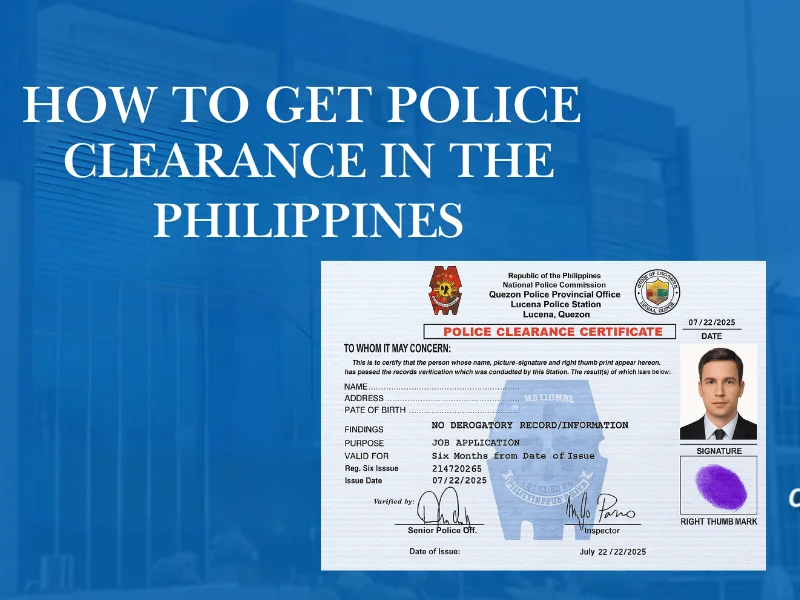
How to Get Police Clearance in the Philippines

Getting a police clearance is one of the most common requirements Filipinos encounter—whether for employment, business, travel, or personal records. While the process is now more streamlined than before, many applicants still feel unsure about where to start, what to prepare, and what actually happens on appointment day.

This guide walks you through how to get police clearance in the Philippines, explained in plain language, with practical tips that reflect how the system really works on the ground.

How to Get Police Clearance in the Philippines

What Is Police Clearance?

Police clearance is an official document issued by the Philippine National Police (PNP) certifying that a person has no criminal record within the locality where the clearance was processed, based on available police databases.

Important Distinction

  • It is local in scope – Police clearance only covers the specific locality or jurisdiction where it was issued. Unlike NBI clearance which has nationwide coverage, police clearance is limited to the area of the issuing police station or city/municipal police office.
  • It differs from NBI clearance – While both documents verify criminal records, NBI clearance provides nationwide coverage and is often required for international purposes. Police clearance is typically used for local employment, business permits, and community-based requirements.

Note: Understanding the scope and limitations of police clearance is essential. If your requirement specifies "nationwide" coverage or is for international use (such as visa applications or overseas employment), you will likely need an NBI clearance instead of or in addition to a police clearance.

Common Uses of Police Clearance

  • Local Employment: Required by many employers for background verification
  • Business Permits: Often needed when applying for business licenses and permits
  • Barangay Requirements: Community-level transactions and certifications
  • School Enrollment: Some educational institutions require it for enrollment
  • Legal Documents: Supporting document for various legal transactions
  • Personal Records: Maintaining clean personal documentation

Pro Tip: Always check with the requesting party whether they need a police clearance or NBI clearance. Some organizations accept either, while others specifically require one or the other. Getting the wrong type means you'll need to apply again, wasting time and money.

Why Filipinos Need Police Clearance

This document is often required for routine but important purposes.

Common Uses

  • Local employment applications
  • Business permits and renewals
  • Barangay or LGU requirements
  • School or internship documentation
  • Proof of good standing for personal records

Tip: Many employers request this first before asking for national clearances.

Who Can Apply?

Police clearance is available to almost everyone.

Eligible Applicants

  • Filipino citizens (18 years old and above)
  • First-time job seekers
  • Students
  • Self-employed individuals
  • Business owners

Note: Minors may be allowed in specific cases, depending on local police policy.

Where Police Clearance Is Issued

Police clearance is processed through:

  • PNP Police Clearance System (PCS)
  • Selected police stations nationwide

Applications are now centralized through an online system, but issuance still happens in person.

How the Process Works

Here's the process at a glance:

  • Online registration
  • Appointment scheduling
  • Payment of fees
  • Police station visit
  • Biometrics & verification
  • Release of clearance

We'll break each step down clearly below.

Step 1: Online Registration

Before anything else, applicants must register through the official police clearance system.

What You'll Need

  • Active email address
  • Mobile number
  • Basic personal details

During registration, make sure your:

  • Full name matches your valid ID
  • Date of birth is accurate
  • Address details are complete

Tip: Errors at this stage can cause delays later.

Step 2: Schedule an Appointment

Once registered, you'll be asked to schedule an online appointment by choosing a police station and date.

Tips When Scheduling

  • Select a station near your residence
  • Morning slots are usually faster
  • Avoid peak days (Mondays & month-end)

Note: Walk-ins are generally not encouraged, as the system prioritizes scheduled applicants.

Step 3: Pay the Required Fee

After scheduling, you'll proceed to payment.

Typical Cost

  • Police clearance fee: ₱150
  • Convenience fee may apply depending on payment method

Common Payment Options

  • E-wallets
  • Online banking
  • Payment centers

Tip: Save or screenshot your payment confirmation.

Step 4: Prepare the Requirements

Before your appointment day, prepare the required documents for police clearance to avoid rescheduling.

Required Documents

  • Valid government-issued ID
    (e.g., UMID, driver's license, passport, PhilSys ID)
  • Appointment confirmation
  • Payment receipt (digital or printed)

Important: IDs must be original and not expired.

Step 5: Go to the Police Station (Appointment Day)

Arrive at least 15–30 minutes early.

What Happens On-Site

  • Verification of identity
  • Biometrics capture (photo & fingerprints)
  • Database checking

Processing Time: Processing time varies but usually takes 30 minutes to 2 hours.

What If There's a "HIT" Record?

A "HIT" means your name matches someone in the database. Learn how to resolve police clearance hit status if this happens to you.

Important Notes

  • It does NOT automatically mean a criminal record
  • Common names are more likely to get flagged

If You Get a HIT

  • Clearance release may be delayed
  • You may be asked to return after verification
  • Additional checks will be conducted

Note: This is normal and manageable—don't panic.

Releasing the Police Clearance

Once cleared:

  • Some stations release it same day
  • Others ask you to return after a few days

Always Check:

  • Correct spelling of your name
  • Date and validity
  • Official seal and signature

Validity of Police Clearance

Police clearance is not permanent and will eventually require police clearance renewal.

Typical Validity:

  • 3 to 6 months, depending on requesting entity

Important: Always confirm validity requirements with whoever requested it.

Common Mistakes Applicants Make

Avoid these frequent issues:

  • Incorrect personal details during registration
  • Bringing expired or photocopied IDs
  • Missing appointment schedules
  • Assuming walk-ins are accepted
  • Not checking clearance details before leaving

Practical Tips for a Smooth Experience

  • Register using your real, legal name
  • Bring backup IDs if possible
  • Dress neatly (some stations enforce dress codes)
  • Be polite and cooperative with officers
  • Avoid peak hours when possible

Police Clearance vs NBI Clearance (Quick Comparison)

Aspect Police Clearance NBI Clearance
Scope Local Nationwide
Issued by PNP NBI
Processing Faster More detailed
Common Use Local jobs Travel, national use

Note: Many employers ask for both, depending on role.

Frequently Asked Questions

No. Registration is required before visiting the station.

Yes, through participating police stations.

Yes, through your online account before the appointment date.

Usually no—NBI clearance is typically required for international use.

Final Thoughts

Learning how to get police clearance doesn't need to be stressful. The system is designed to be straightforward—as long as you follow the steps, prepare your documents, and give yourself enough time.

For most applicants, the process is quick, affordable, and manageable—especially when compared to older manual systems.