
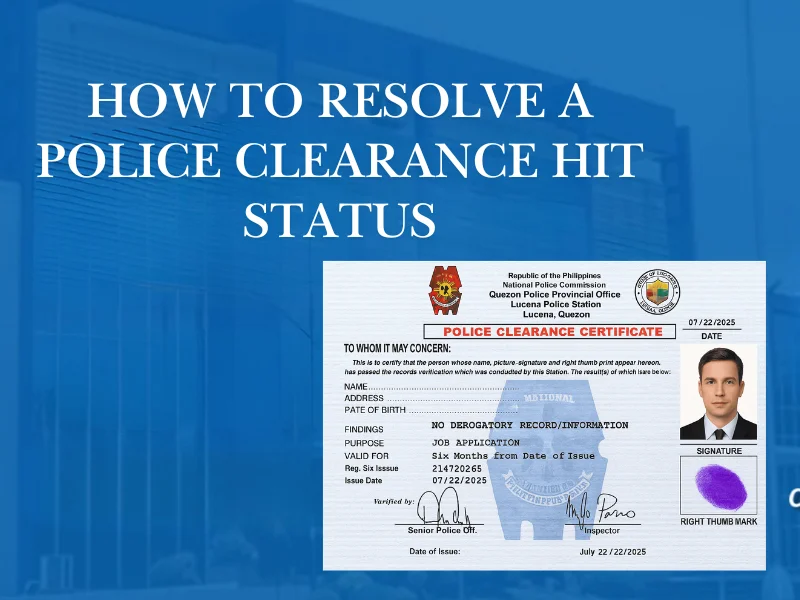
How to Resolve a Police Clearance HIT Status in the Philippines

Seeing a HIT status on your police clearance application can feel stressful—especially if you urgently need the document for employment, travel, or permanent residency. Many applicants assume it means rejection or a serious legal issue. In reality, a HIT status is far more common and far less alarming than most people think.

How to Resolve a Police Clearance HIT Status
Understanding HIT

What Is a Police Clearance HIT Status?

A HIT status simply means that your personal details matched or closely resembled an existing record in the police database. This triggers manual verification before your clearance can be released.

A HIT is not a denial

It is a temporary hold for verification, not a rejection of your application.

A HIT does not mean you have a criminal record

Most HITs are due to name similarities with other individuals.

A HIT is a verification safeguard

It ensures that the clearance is issued only to the correct person.

System Purpose

Why HIT Status Exists

In a country with many shared surnames and first names, HIT verification is a necessary accuracy step. The system is designed to protect both the applicant and the public.

Prevention

Prevent identity mix-ups

Ensures that records belonging to someone else aren't attributed to you.

Security

Protect applicants with similar names

Prevents innocent citizens from being flagged for someone else's history.

Validation

Ensure accurate record verification

Allows officers to double-check details like DOB and middle names.

Trust

Maintain the credibility of clearances

Keeps the police clearance certificate a trusted document for all agencies.

Common Causes

Common Reasons for Getting a HIT Status

Most HIT statuses are triggered by data overlaps rather than actual criminal records. Here are the most frequent causes:

Same or similar full name

Shared surnames and first names are the most common reason for a HIT.

Similar date of birth

Matches in name plus similar birth dates require extra verification steps.

Matching middle name

Data overlap in middle names often leads to manual data cross-referencing.

Previous police record

Even minor or cleared cases require manual review before a new release.

Important Note: Even applicants with no criminal history can receive a HIT. It is simply a verification safeguard in the national database.
Applicant Likelihood

Who Is Most Likely to Get a HIT?

While anyone can receive a HIT, certain applicant profiles are more prone to matching records in the national database.

Applicant Type HIT Likelihood
Common Filipino names (e.g., Jose, Maria, Santos) High
Multiple past clearances or renewals Medium
Recent address changes (unverified updates) Medium
First-time applicants Low–Medium
Unique names (atypical spellings) Low
Post-HIT Process

What Happens After You Get a HIT Status?

Once your application is flagged with a HIT, the system shifts from automated processing to human-led verification. Here is the step-by-step resolution:

1

Your application is paused

The system prevents immediate printing to ensure no erroneous records are issued.

2

Records are manually reviewed

An officer cross-references your details with the database record that triggered the match.

3

Identity confirmation is required

You may be asked to provide secondary IDs or wait for the system to clear the name overlap.

4

Clearance is either approved or verified

Once the officer confirms you are not the person with the record, the clearance is released.

Accuracy First: This process ensures accuracy over speed, protecting you from being wrongly associated with another person's record.
Expected Timelines

How Long Does HIT Verification Take?

The waiting period varies depending on how many records need to be checked and the complexity of the data overlap.

Scenario Estimated Time
Simple name match (no criminal history) 3–7 working days
Multiple similar records in the database 7–14 working days
Manual record comparison (complex data) Up to 15 working days
Note: Processing time depends on record complexity—not applicant fault. If it takes longer, it usually means the system is being thorough.
Process Workflow

The Lifecycle of a HIT Status

Understanding the progression of a HIT status helps manage expectations. Here is how your application moves through the system from start to finish.

1

Application Submitted

Your data enters the PNP national database for automated cross-referencing.

2

HIT Detected

The system flags a name or data match with an existing criminal record.

3

Manual Verification Initiated

A verification officer is assigned to manually review the record match.

4

Applicant Confirmation

You may be asked to provide more info or visit the station to verify your identity.

5

Record Cleared

The officer confirms that the record does not belong to you or has been resolved.

6

Clearance Approved

Your certificate is finally authorized for printing and release.

Common Scenario

What If the HIT Is Due to a Namesake?

This is the most common scenario in the Philippines. Because many citizens share identical surnames and first names, the database frequently flags innocent individuals.

No need to panic—it's just a routine name check.
Verification Criteria

What Officers Look For

To distinguish you from a person with a criminal record, verification officers look beyond just names and focus on specific data discrepancies.

Different Addresses

Current and previous residential records help differentiate namesake individuals.

Different Birthdates

One of the strongest filters for separating two people with the same name.

Different Parents’ Names

Officers check the names of your father and mother as listed in your application.

Different Biometric Data

Unique markers like fingerprints and digital photos provide definitive proof of identity.

Crucial Rule: Names alone are never enough to deny a clearance. Officers must verify these additional details before any final decision is made.
Rejection Risks

Can a HIT Status Be Rejected?

While many worry about rejection, it is extremely rare and usually occurs only under specific circumstances:

Identity cannot be verified: If you fail to present valid ID or provide inconsistent biometric data.

Information is inconsistent: Major discrepancies between your provided details and official IDs.

Required documents are missing: Failure to provide supplementary documents requested by the officer.

Even in these cases, applicants are usually given time to comply and submit the correct requirements before a final rejection is issued.
Action Plan

How to Resolve a Police Clearance HIT Status Step-by-Step

If your application returns a HIT status, follow these steps to ensure a smooth and successful resolution. Handling it correctly prevents further delays.

Phase 01

Do Not Reapply Immediately

Duplicate applications are the #1 cause of further delays. Avoid creating new accounts or submitting fresh requests.

No Re-applications No Duplicate Accounts
Phase 02

Wait for Instructions

The system needs a few days to route your HIT to a verification officer. Monitor your email and online dashboard daily.

Check Email Check Portal
Phase 03

Prepare Essentials

Gather your original government IDs and payment receipts. If you have an old clearance, keep it ready for comparison.

Phase 04

Visit the Station

Head to your assigned police station if requested. This is a standard administrative check to verify your identity manualy.

Professional Tip: Arrive during morning hours.
Phase 05

Final Verification

Confirm your fingerprints and photo on-site. Once the match is cleared, your clearance will be approved for release.

Approved for Release
Comparison

HIT Status vs Criminal Record

It is important to understand that a HIT status is an administrative flag, not a confirmation of a criminal history. Here is a direct comparison between the two.

Aspect HIT Status Criminal Record
Automatic flag Yes No
Requires verification Yes Case-specific
Common Very Less common
Means wrongdoing No Not always
Prevention Tips

How to Avoid HIT Status in the Future

While not always preventable (especially with common names), you can reduce your chances of being flagged by following these best practices:

Full Legal Name

Use your full middle name and legal spelling consistently on every application.

Avoid Abbreviations

Never abbreviate your name or address. System mismatches often start with slight variations.

Update ID Details

Ensure your government IDs are updated with your current address and status.

Single Account Policy

Only maintain one official NPCS account to avoid system conflicts and verification delays.

Common Questions

Frequently Asked Questions

No. A HIT status is not a failure. It only means the system requires a manual check to ensure the clearance is being issued to the right person.

Processing must follow standard verification rules for legal accuracy. Attempting to rush the process can sometimes cause administrative errors, so patience is advised.

Most employers in the Philippines are familiar with the HIT status and understand it is a standard procedural step, not a negative reflection on the applicant.

No. If manual verification or biometrics are required, the applicant must appear personally. Identity verification is a non-transferable security step.

Expert Tip

Expert Tip for Urgent Applications

If you need your clearance immediately for critical requirements, follow these recommendations to potentially expedite your case.

If your clearance is for:

Overseas employment
Immigration or residency
Court submission
Conclusion

Final Thoughts

A national police clearance HIT status exists to protect identities, not to accuse applicants. It is a safeguard designed to ensure that the document you receive is 100% accurate and belongs specifically to you. Most HIT cases are resolved smoothly once verification is completed.

"Patience and transparency are your best tools when resolving a HIT status."